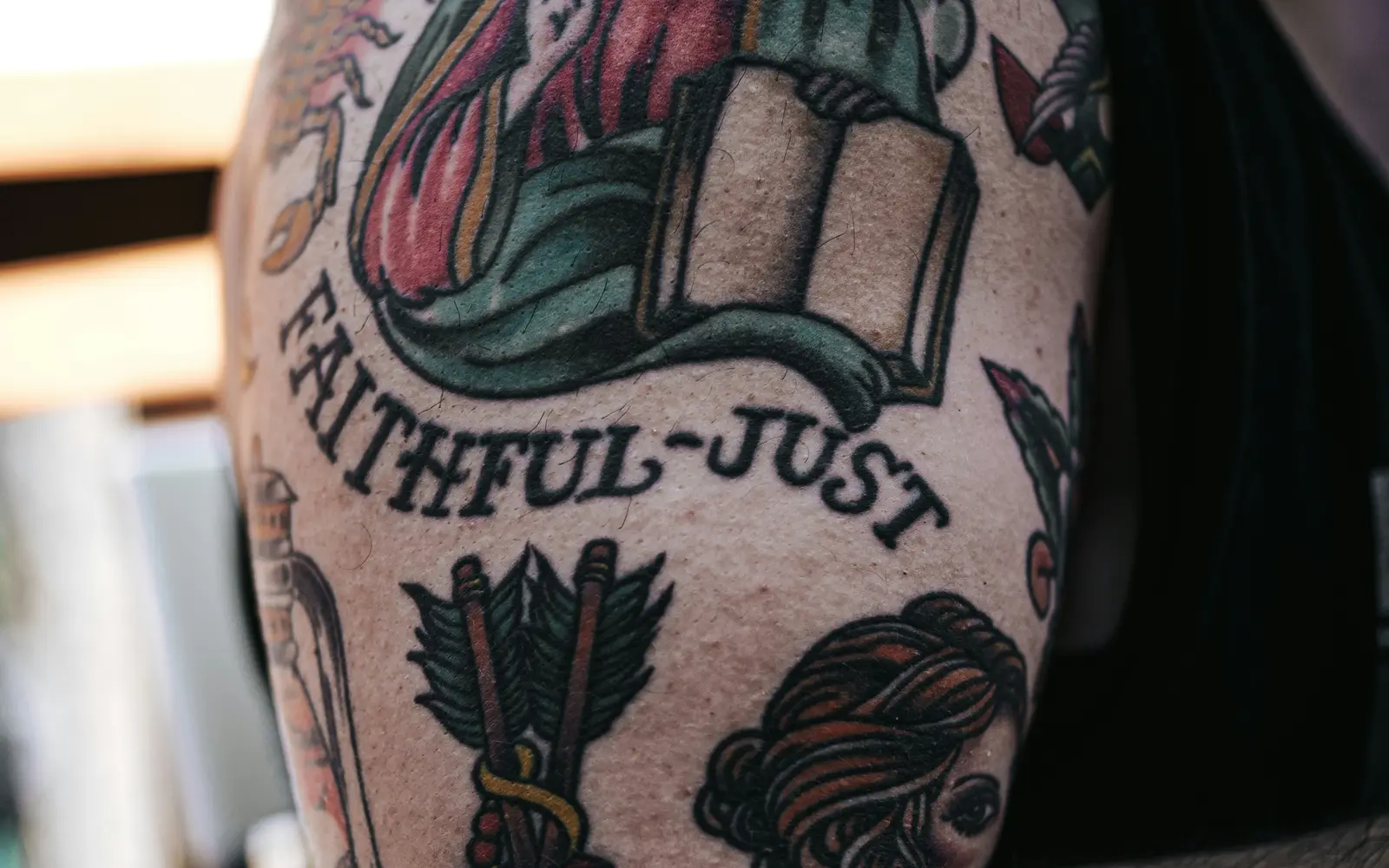
Old School is the original tattooing language of American sailors, carnival workers, and working-class folk from the early 20th century. It's defined by a very short list of rules: thick, confident black outlines, a limited palette (red, yellow, green, black, and not much else), high-contrast solid fills, and subjects drawn from the classic flash vocabulary: roses, anchors, daggers, panthers, eagles, pin-ups, swallows. If you've seen a Norman Collins ('Sailor Jerry') design or a vintage Navy port poster, you know the style. The reason it's survived over a hundred years is simple: those rules are functional, not decorative. Thick lines don't bleed into each other. Solid fills don't shift the way gradients do. High contrast reads at distance. An Old School tattoo from 1945 is still legible in 2026, and one done today will be legible in 2126. What most people miss is how disciplined the style actually is. Flash subjects weren't chosen arbitrarily: a swallow meant you'd sailed 5,000 miles, a anchor meant merchant navy, a rose balanced the harder imagery. The symbolism is baked in. Working-class tattooers refined the visual grammar over decades, and what we call 'classic flash' is the accumulated result of that editing process. Modern Old School work keeps the grammar intact: if you could mistake the piece for a laptop sticker or a watercolor print, it's something else. If it reads like something that belongs on a sailor's forearm in 1942, you're in the right territory.
Pick this style if...
- Anyone who wants a tattoo that will still look sharp at 70 years old
- Bold, graphic pieces with visual punch from across the room
- Classic subjects (animals, nautical, Americana, flora) with enduring symbolism
Skip this style if...
- You want fine detail, subtle gradients, or a photorealistic look
- You want to stray far from the classic flash vocabulary
- You're booking based on price alone: the line work quality is everything
Notable artists
A starting point. Follow their work, don't just book the first DM-slot you can get.
- Norman Collins (Sailor Jerry)
- Owen Jensen
- Paul Rogers
The rules of the style
- Heavy black outlines are the backbone: lines thick enough to hold for decades, never hairlines, never broken.
- Flat, solid color fill: no gradients, no blends. Solid red, solid yellow, solid green inside clean black borders.
- Strict limited palette: black, red, yellow, green, and occasionally blue or purple. Every color must read clearly at arm's length.
- Classic flash subjects are the vocabulary: roses, eagles, daggers, anchors, swallows, pin-ups, skulls, snakes, hearts. Each motif has earned its place through decades of proven readability.
- High contrast above everything: the silhouette must read in five seconds or it won't survive 20 years of fading.
- Designed to age, not just to photograph. Every design decision serves longevity, and a great Old School piece looks better at 30 years healed than most modern styles do at 3.
Color palette
- Black
- Opaque red
- Cadmium yellow
- Forest green
- Cobalt blue (secondary)
- Purple (secondary)
The restraint of the palette is part of the style's identity. Pastels, muted tones, gradients, and extended palettes shift it toward Neo-Traditional, which is a different (younger, more complex) style.
Aftercare for this style
Old School heals predictably well: the thick outlines act as borders that keep color from migrating, and solid fills peel evenly rather than in patches. Expect moderate swelling and redness for the first two days, then a peeling phase where the bright colors look dull and flaky. That's normal. Don't pick. The reds and yellows will pop back once the skin settles, usually by week three. The main risk with older-style solid color is overworking during the session; a good Old School artist won't saturate a color multiple times in one sitting, so trust your artist's pace. SPF 30+ after full healing preserves the color contrast the piece was built on.