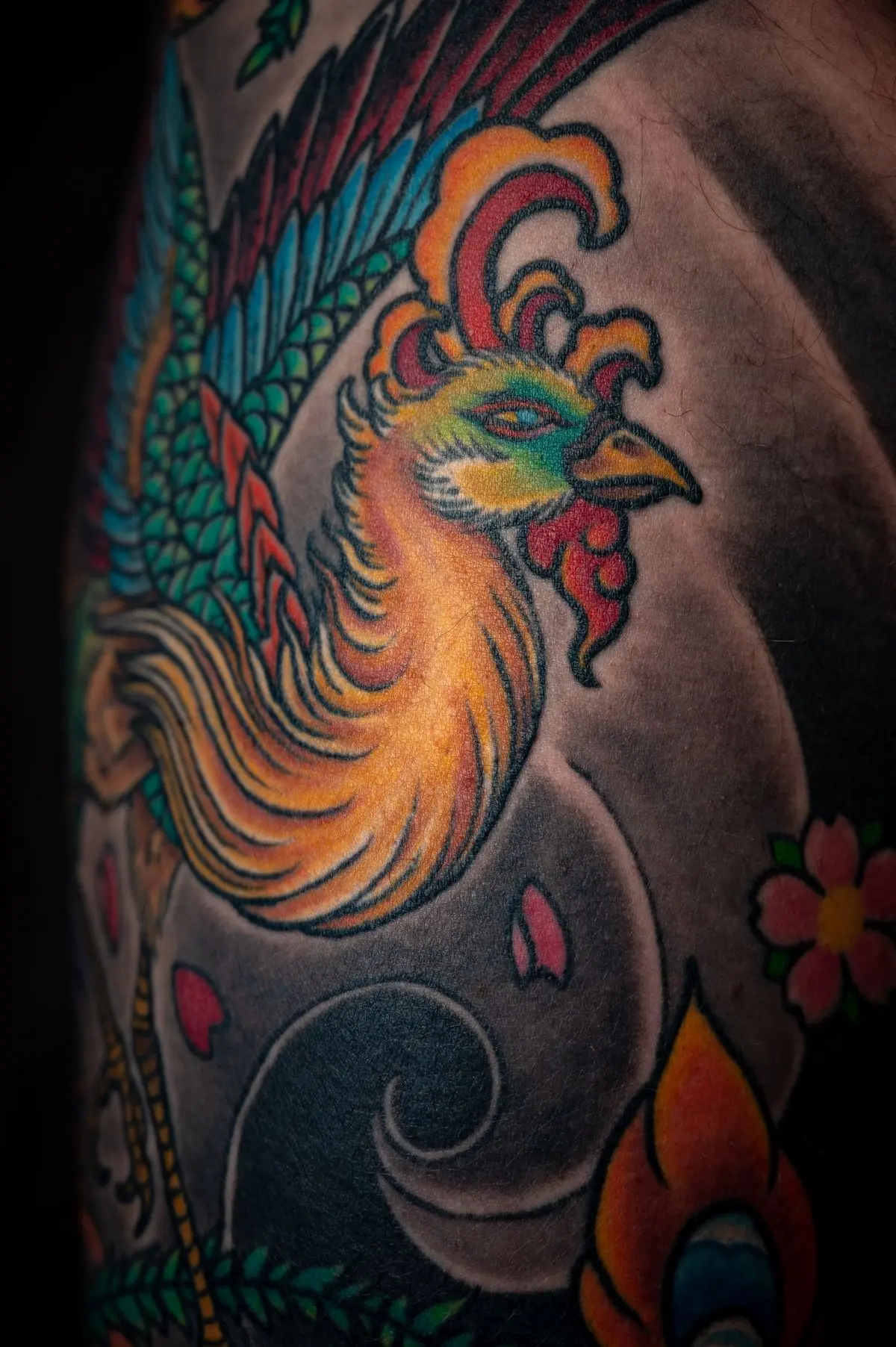
Neo-Traditional is what happens when tattoo artists trained in American Traditional start caring about color theory and anatomy. The structural foundation is unchanged (bold outlines anchor every form), but everything inside those outlines gets expanded. Flat fills become layered shading. The six-color traditional palette opens to any saturated hue. Subjects that traditional's flash vocabulary never included, like complex portraits, architectural subjects, surreal animals, and botanical compositions, become possible within the bold-line framework. The style developed organically through the late 1990s and 2000s, as a generation of American and British artists absorbed the Traditional lineage while simultaneously studying illustration, printmaking, and fine art. There was no single founding moment; it emerged as artists like Emily Rose Murray, Russ Abbott, and Jeff Gogué began producing work that was clearly descended from Traditional but couldn't be categorized as flash. Neo-Trad is technically more demanding than Traditional in one direction and equally demanding in another: the rendering complexity inside each piece is higher, but the bold outline structure still does most of the heavy lifting for longevity. A neo-trad piece ages nearly as well as a traditional one for exactly this reason: the outlines hold the design together through decades of ink softening. Color fades and tones compress, but the graphic read at a distance stays intact. Neo-Trad also tolerates more unusual placement than pure Traditional because the compositional flexibility allows designs to wrap contours more naturally than flat flash does.
Pick this style if...
- Collectors who love traditional aesthetics but want more color range
- Medium-to-large pieces with narrative or stylized subjects
- Combining with existing traditional work
Skip this style if...
- You want photographic realism
- You want pure black-ink longevity
Notable artists
A starting point. Follow their work, don't just book the first DM-slot you can get.
- Emily Rose Murray
- Jeff Gogué
- Russ Abbott
The rules of the style
- Bold outlines, but with variation: neo-traditional keeps the structural boldness of American Traditional but uses line weight variation to create depth and dimension that flat traditional doesn't attempt.
- Expanded subject matter, since any subject is valid. While traditional is limited to its flash vocabulary, neo-trad applies the bold-outline structure to portraits, animals, botanicals, fantasy, architecture, anything.
- Color as dimension: where American Traditional uses flat fills, neo-trad layers color to create shadow, highlight, and form. It looks painted rather than printed.
- More detail, more complexity. Traditional pieces are designed to read as a silhouette from distance, but neo-trad adds internal detail that rewards closer inspection without sacrificing the bold graphic read.
- Decorative framing is common. Banners, frames, ornamental borders, and decorative fill elements (like chrysanthemums or filigree) are used to define the composition in ways traditional doesn't.
- Must still age well. The bold outlines anchor neo-trad pieces through the years, and artists who chase detail at the expense of structure produce neo-trad work that falls apart at 10 years.
Color palette
- Black
- Deep red
- Forest green
- Cobalt blue
- Purple (secondary)
- Gold/yellow (secondary)
- Teal (secondary)
- Coral (secondary)
- Dusty rose (secondary)
Neo-trad has no palette restriction. The only rule is intentional color use: every color should serve the composition. Muddy or arbitrary color is a craft failure, not a style choice.
Aftercare for this style
Neo-Traditional follows the same basic fresh-tattoo routine as other styles: follow your artist's instructions, keep the area clean, and protect the healed tattoo from UV exposure.