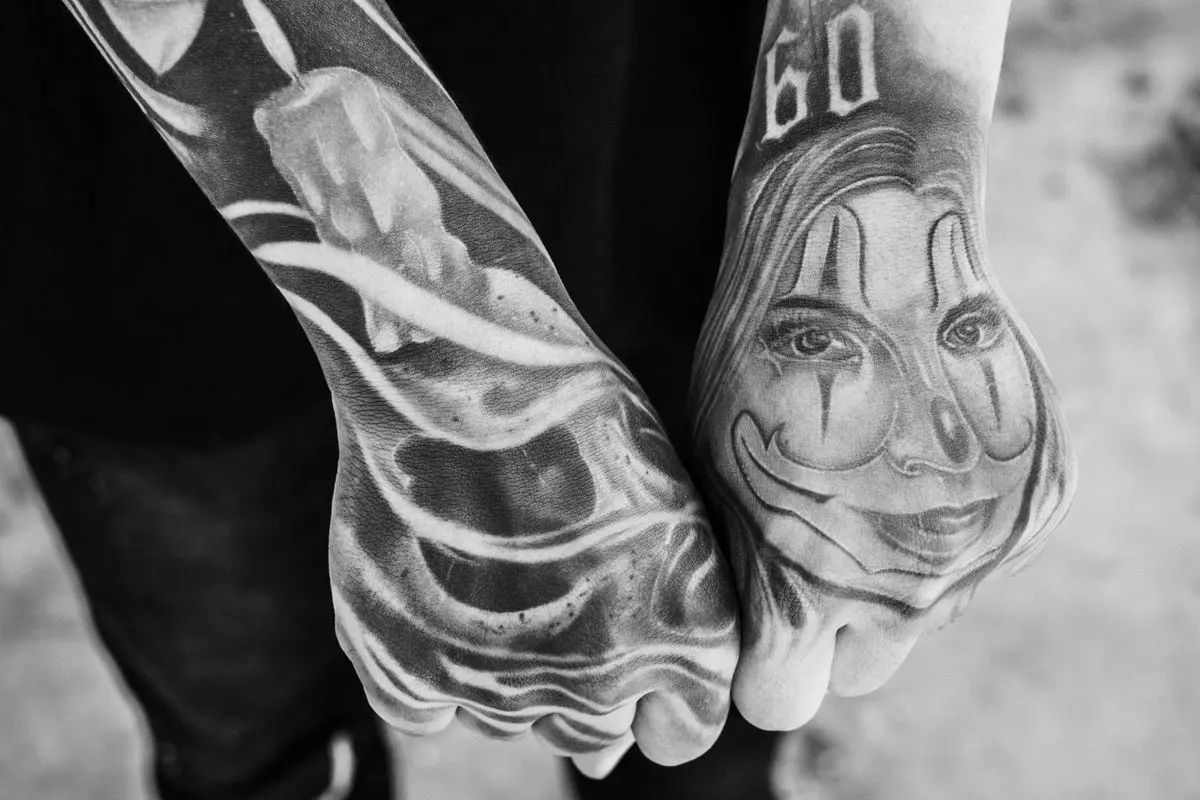
Chicano tattooing is the defining American black-and-grey tradition. Its visual signature is an extraordinary range of grey tones built from a single needle and diluted black ink: smooth washes that transition from deep shadow through mid-tone into skin highlights so gradually the eye struggles to find the edge. Nothing is outlined in the conventional sense; form emerges entirely from value, the way a charcoal drawing or a graphite portrait does. The style emerged from 1940s and 1950s Mexican-American barrio communities in Southern California, shaped by the visual culture of pachuco life, lowrider car customization, and the Catholic devotional imagery that ran through both. Prison tattooing accelerated the form: in an environment where color ink was unavailable and machines were improvised from motors and guitar strings, artists developed the single-needle grey-wash technique as a solution to material constraint, and the aesthetic became its own tradition. Jack Rudy and Charlie Cartwright brought chicano-style black and grey out of the barrio and into mainstream tattooing in the 1970s and 1980s; Freddy Negrete and Mister Cartoon expanded it into fine art contexts. The iconography is specific and carries real weight: the Virgin of Guadalupe, Santa Muerte, la llorona, clowns and tears (payasos), roses, religious medallions, and memorial portraiture of lost loved ones. Script is foundational: Old English, gothic cursive, and block lettering appear in almost every piece, and the best chicano letterers are as skilled as calligraphers. This is also one of tattooing's premier portrait traditions: the grey-wash technique, when executed at a high level, captures facial likeness more convincingly than most other approaches.
Pick this style if...
- Black and grey enthusiasts
- Script and portrait work
- Collectors valuing cultural depth
Skip this style if...
- You want pure color work
- You're uncomfortable with religious or cultural imagery
- You can't find an artist with actual lineage (it shows)
Notable artists
A starting point. Follow their work, don't just book the first DM-slot you can get.
- Freddy Negrete
- Mister Cartoon
- Jack Rudy
The rules of the style
- Black and grey is the default: chicano tattooing is historically a black-and-grey style. Color exists in the tradition but B&G is the defining aesthetic.
- Fine shading, not flat fill: unlike American Traditional's flat color blocks, chicano work builds form through smooth grey wash and fine shading, achieving a painted or pencil-drawn quality.
- Script lettering is foundational: Old English, cursive script, and block lettering are central to the style. Chicano artists are typically exceptional letterers.
- Specific iconography: Our Lady of Guadalupe, roses, clowns (payasos), poker cards, eyes, teardrops, clock faces, lowrider cars, portraits of loved ones. Each motif carries cultural and personal weight.
- Portrait work is common and expected: chicano tattooing has a long tradition of memorial and tribute portraiture. The style's fine shading technique is well-suited to facial likeness.
- Cultural roots matter: chicano tattooing emerged from Chicano/Mexican-American communities in California, with strong ties to pachuco culture, prison tattooing, and lowrider culture. It is a living tradition, not just an aesthetic.
Color palette
- Black
- Cool grey
- Warm grey
- Red (roses, hearts) (secondary)
- Brown skin tones (portraiture) (secondary)
Color chicano exists but the B&G constraint is what defines the style's look. If you want color, discuss whether it fits the specific piece: some motifs (roses, sacred hearts) translate well to color chicano; others don't.
Aftercare for this style
Chicano follows the same basic fresh-tattoo routine as other styles: follow your artist's instructions, keep the area clean, and protect the healed tattoo from UV exposure.